DOSSIER.
The hardware, the ground, and the agencies behind the fiction. Real things, briefly described.
F-111 AARDVARK.
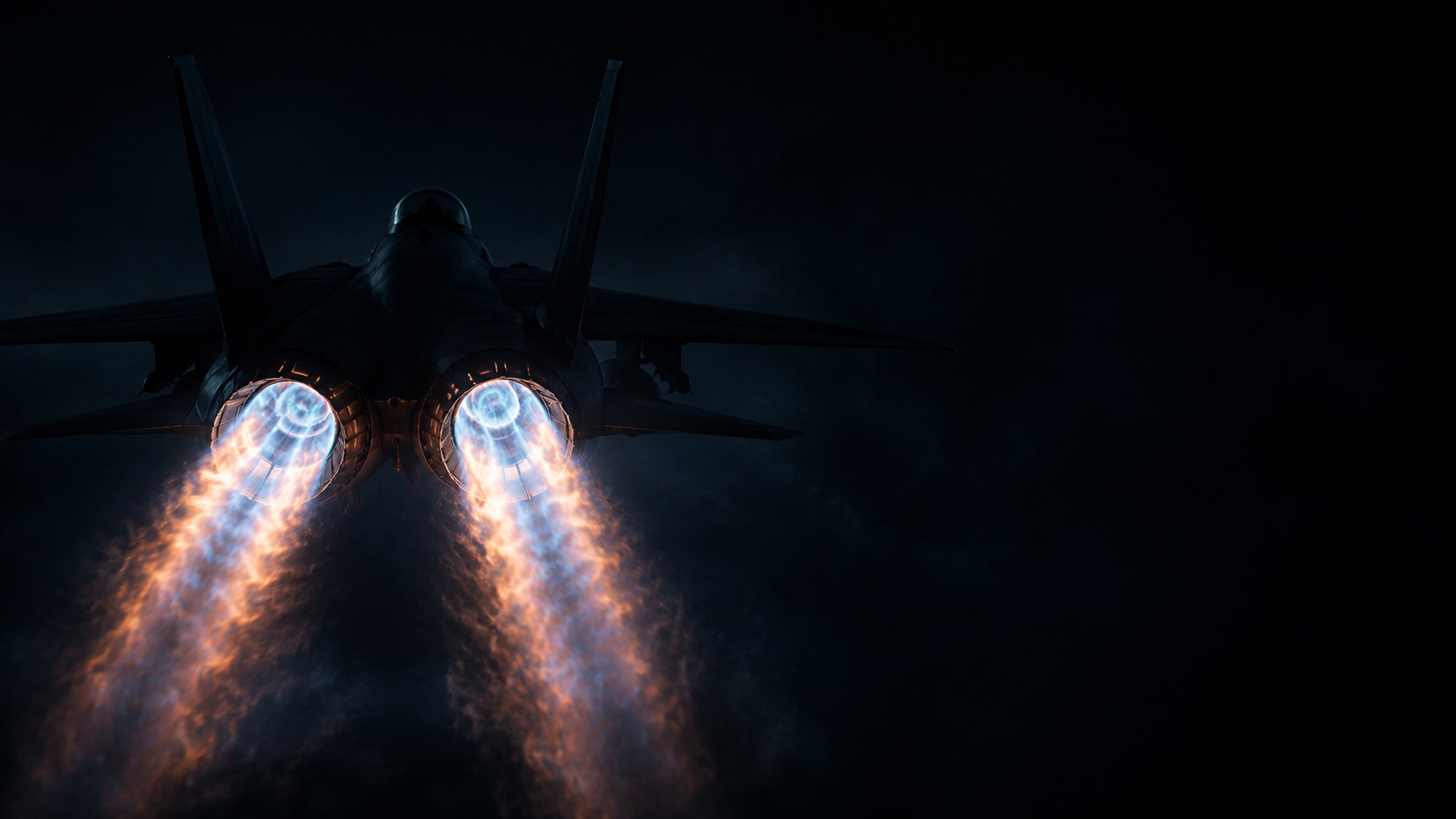
A long-range, supersonic, variable-sweep tactical strike aircraft. First fielded in 1967, the F-111 pioneered terrain-following radar, afterburning turbofans, and a side-by-side two-seat cockpit. Crews called it the Vark.
Unlike most tandem-seat fighters, the F-111's pilot and Weapon Systems Officer: the Wizzo, sat shoulder to shoulder. The Wizzo's head spent most of a sortie inside the feedbag, the hooded enclosure over the radar and infrared scopes, while the pilot flew the airplane through whatever the terrain and the weather provided.
The F-111F variant, flown out of RAF Lakenheath, carried the Pave Tack laser-designation pod and was the airframe of choice for Operation El Dorado Canyon: the 1986 strike on Libya. The type served the USAF until 1998.
In Delta 7, Carter's combat record begins in an F-111F over the Mediterranean. The low-level penetration, the TFR letdown, the comm-out join-up on the tanker: all drawn from time on the airframe.
COLOMBIA.
Most of Delta 7 is set in Colombia. Cartagena, Bogotá, Cali, the coastal corridor, and the jungle interior of the Guainía Department. The novel reflects the country in the years when the big cartels had collapsed into smaller, harder structures and the FARC still held terrain in the south.
Chapter Two opens with a Colombian boy pressed into service with the 38th Cuadrilla of the 16th Front of the FARC. His first ambush is one of the book's set pieces.
The author served two tours as a U.S. defense attaché in the region. The cities, the routes, the protocol of the embassy circuit: drawn from working memory, not research.
COLOMBIAN DEFENSE FORCES.
The Colombian military has been at war for decades. Unlike many of its Latin American neighbors, its focus has been internal. Rather than orienting its forces and doctrine to defend the borders, the Colombian military has fought a well-armed insurgency on its own territory.
Its human rights record has been challenged over the years. It remains a largely professional and efficient fighting force, and Delta 7 names real units throughout: army battalions, naval infantry, the Air Force, and the National Police.
The primary focus of the U.S. Embassy's Defense Attaché Office (DAO) was to serve as the ambassador's experts in all things military and to continuously assess the readiness and capabilities of the Colombian military. The author served as Assistant Air Attaché to Colombia, with primary responsibility for the Colombian Air Force and the management of the DAO's C-12 flying program. The C-12 is the military version of the Beechcraft Super King Air.
From many visits to units throughout the country, the impression that stuck was the spirit and professionalism of the people in uniform. That impression is on the page in Delta 7.
FARC, ELN, AUC.
Three organizations move through the background of Delta 7. The FARC: Fuerzas Armadas Revolucionarias de Colombia, founded in 1964 as a Marxist-Leninist peasant army. By the period of the novel they no longer fought for ideology. They fought to finance themselves through kidnapping, extortion, and the cocaine trade.
The ELN: Ejército de Liberación Nacional, smaller, also leftist, also long-lived. Founded by Catholic radicals and Cuban-trained cadres in the same decade as the FARC. They pioneered the kidnapping economy in the eastern oil fields.
The AUC: Autodefensas Unidas de Colombia, a right-wing paramilitary umbrella that grew out of cattle-rancher self-defense groups and quickly became a parallel narco-army. They demobilized formally in 2006. Many of the people did not.
Delta 7 puts a sixteen-year-old conscript inside the FARC for Chapter Two. The boy and his unit are imagined. The structure they sit inside: cuadrillas, frentes, comandantes, is real.
THE 2008 HOSTAGE RESCUE.
In July 2008, the Colombian military rescued fifteen hostages from the FARC in a bloodless operation that read like fiction. Three U.S. defense contractors. The former presidential candidate Íngrid Betancourt. Eleven Colombian soldiers and police. Several of them had been held in the jungle for more than five years.
The operation: code-named Jaque, was a deception. Colombian intelligence officers posed as members of an international humanitarian NGO and convinced the FARC unit holding the hostages to load them onto a helicopter for transfer to a senior commander. The helicopter took them to freedom instead.
Delta 7 was written in the aftermath of that period. The author served in Colombia as a military attaché during years when the FARC still controlled large tracts of the south, when the kidnapping economy was at its peak, and when the U.S. Embassy in Bogotá was deeply engaged in helping the Colombian government push back. The book carries that texture.
GRENADA.
St. George's, Grenada, is where the trouble starts. A casual conversation at a bar: the kind of small talk a pilot makes a thousand times, sets the entire plot in motion. Several central characters are members of the Royal Grenadian Police Force or the Grenadian Defense Force.
Grenada is also where, in 1983, a U.S.-led intervention removed a Marxist-Leninist government in a 72-hour operation called Urgent Fury. It is still commemorated on the island as Thanksgiving Day. Several characters in Delta 7 carry the memory of that week with them.
While assigned as an attaché in Venezuela, the author was also diplomatically accredited to Grenada. He has been back many times since, flying the 737 in for American.
PANAMA.
One of Delta 7's characters runs a small business in Panama City and gets pulled into the same trafficking web that pulls in everyone else. The northern port of Colón also figures in the novel, when a container ship leaves the harbor northbound for Mobile, Alabama, and stops being a normal cargo run.
The author served as Assistant Executive Officer to two commanders of U.S. Southern Command in Quarry Heights, Panama: SOUTHCOM's last year in country before the headquarters moved to Miami.
THE ALPHABET.
SOUTHCOM, DEA, DIA, NSA, USCG. The acronyms move through the novel because they moved through the work.
U.S. Southern Command owns the area of responsibility from Mexico south, headquartered west of Miami International. The Drug Enforcement Administration runs the source-country operations. The Defense Intelligence Agency runs the attaché system Carter came up through. The National Security Agency tracks signals on the players. The Coast Guard owns the interdiction on the water: including the at-sea boarding that closes one of the book's arcs.
The seams between these organizations: who reports to whom, who owns the asset, who gets the credit, are where Delta 7 lives.
THE COVER.
A helmet. A jungle scene and an aircraft superimposed on the visor. The marks that look like scratches are the bayonet plugs that connect the oxygen mask to the helmet.
The cover was designed by the author's daughter, Nicole. The photograph on the visor is the author himself, standing in front of a mirror, wearing his USAF helmet for the first time in twenty years. The outflow valve on the mask was stuck. He held his breath for the shot.
MILITARY JARGON.
The novel uses the working language of the people in it. Below: the acronyms and terms that recur, with pronunciation where it matters.
- AIRA
- Air Attaché.
- ALUSNA
- U.S. Naval Attaché.
- ARMA
- Army Attaché.
- AUC
- Autodefensas Unidas de Colombia. Colombian paramilitary organization.
- COGATT
- Coast Guard Attaché.
- CT
- Counter Terrorism.
- DAO
- Defense Attaché Office. Spoken as the letters: D-A-O.
- DAS
- Defense Attaché System.
- DATT
- Defense Attaché. Ranking member of the DAO, normally a full Colonel.
- DIA
- Defense Intelligence Agency.
- DIAC
- Defense Intelligence Analysis Center.
- EL DORADO CANYON
- Code name for the 1986 U.S. raid on Libya.
- ELN
- Ejército de Liberación Nacional. Colombian guerrilla group.
- FAO
- Foreign Area Officer. Military career specialty for overseas service.
- FARC
- Fuerzas Armadas Revolucionarias de Colombia. Pronounced FARK.
- HARM
- High-Speed Anti-Radiation Missile. Used to defeat enemy radar sites.
- HMCS
- Her (or His) Majesty's Canadian Ship.
- JIATF-SOUTH
- Joint Interagency Task Force – South. Pronounced Jyat-if.
- JOIC
- Joint Operations Intelligence Center. Combatant-command fusion cell.
- NIK
- Narcotics Identification Kit.
- NSA
- National Security Agency. Primary U.S. signals-intelligence agency.
- OPORD
- Operations Order. Written military orders for an operation.
- TACON
- Tactical Control. Command authority granted to a subordinate unit.
- TFR
- Terrain-Following Radar. Couples to the autopilot for hands-off low-level flight.
- UNITAS
- Latin for unity. Long-running multinational naval exercise.
- UNREP
- Underway Replenishment. Seaborne transfer of fuel and stores.
- WSO
- Weapon Systems Officer. Pronounced Wizzo. In the F-111, sits right seat.
- ZODIAC
- Rubber-hulled skiff with an outboard. Also called a RIB: Rigid Inflatable Boat.